
Professional Server Support
Windows and Linux servers administered properly: hardening, updates, performance, recovery. With an SLA behind them.
Servers are where a small IT problem becomes a company problem: one box serves everyone, so one misconfiguration, missed update or full disk lands on every desk at once. Server support is the discipline of running them properly: hardened builds, scheduled updates, monitored performance, rehearsed recovery.
We support Windows and Linux, physical and virtual, on-premise and in the cloud. Where a server also carries a database or a line-of-business application, we coordinate with the vendor so responsibility never falls into the gap between “the server is fine” and “the app is down”.
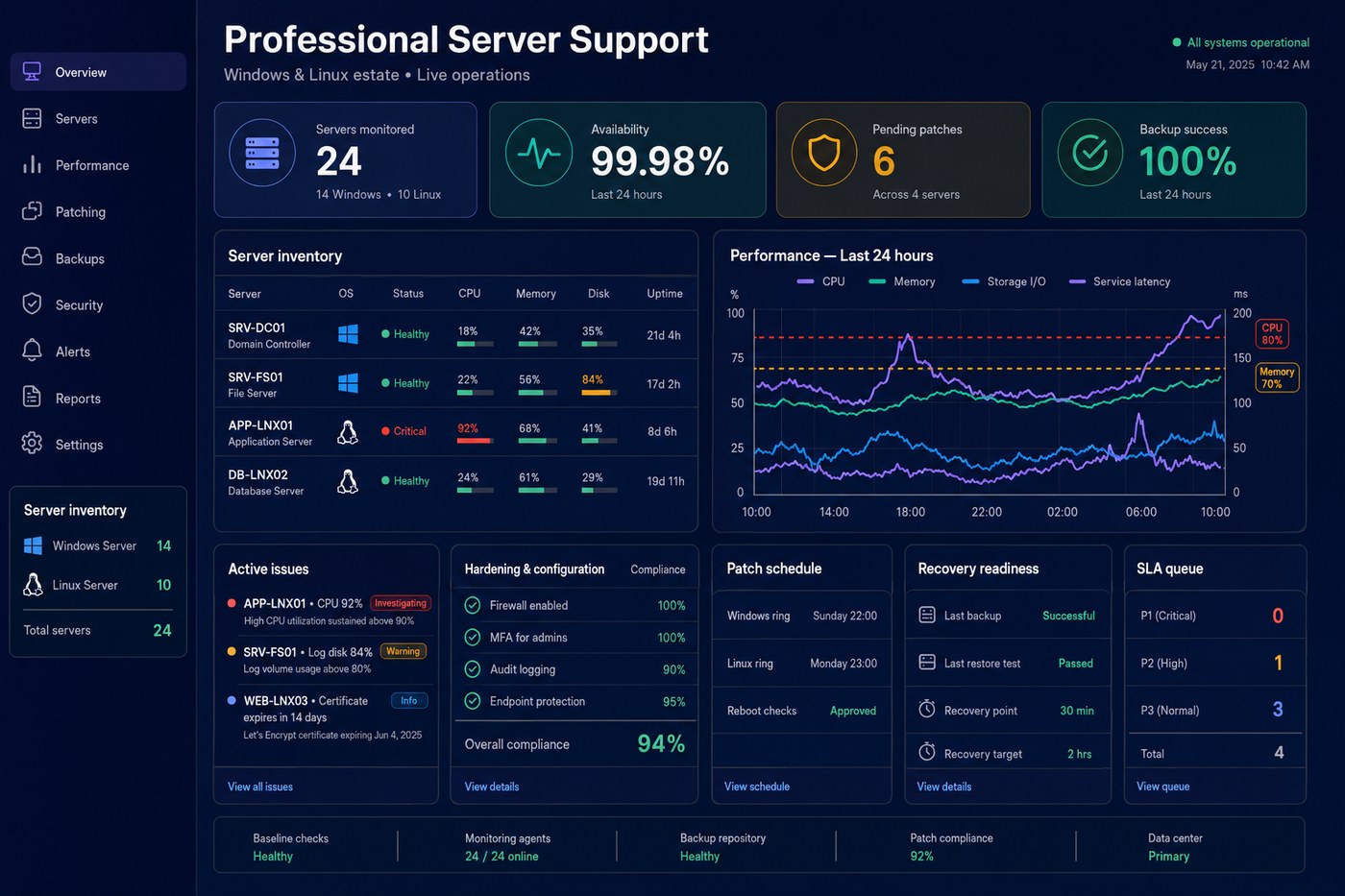
What the service includes
Hardening & configuration
Server builds locked down to a documented standard: services, access, logging, backup agents.
Update & reboot management
Patches and reboots in agreed windows, with health checks before and after.
Performance & capacity
CPU, memory, storage and service latency trended, upgrades proposed before users complain.
Recovery drills
Restore procedures documented and rehearsed, per server, with measured recovery times.
Why it pays off
- One server incident stops taking the whole company with it
- Updates happen on a calendar your business agreed to
- Vendor coordination without responsibility gaps
- Recovery times known before you need them
The return for your business
An hour of server downtime is paid for by everyone who cannot work during it. What that costs is your arithmetic rather than ours, and the calculator on the managed-IT Insight works it out from figures you enter.
An illustration, not a past project
The ERP server that stopped fainting
A distributor’s ERP froze most month-ends, the server had been sized years earlier for half the load. Trend data showed memory exhaustion during closing runs. A planned upgrade (client-procured to our specification), a reindexed database and a rescheduled backup job later, month-end closing ran clean, and has, in every closing since the change.
Start with a conversation
An initial consultation with a consultant rather than a salesperson, about your IT, security or systems question.