
Virtualisation
VMware, Hyper-V or Proxmox: one small resilient cluster instead of a room of under-used servers, on the platform your workloads and licences actually justify.
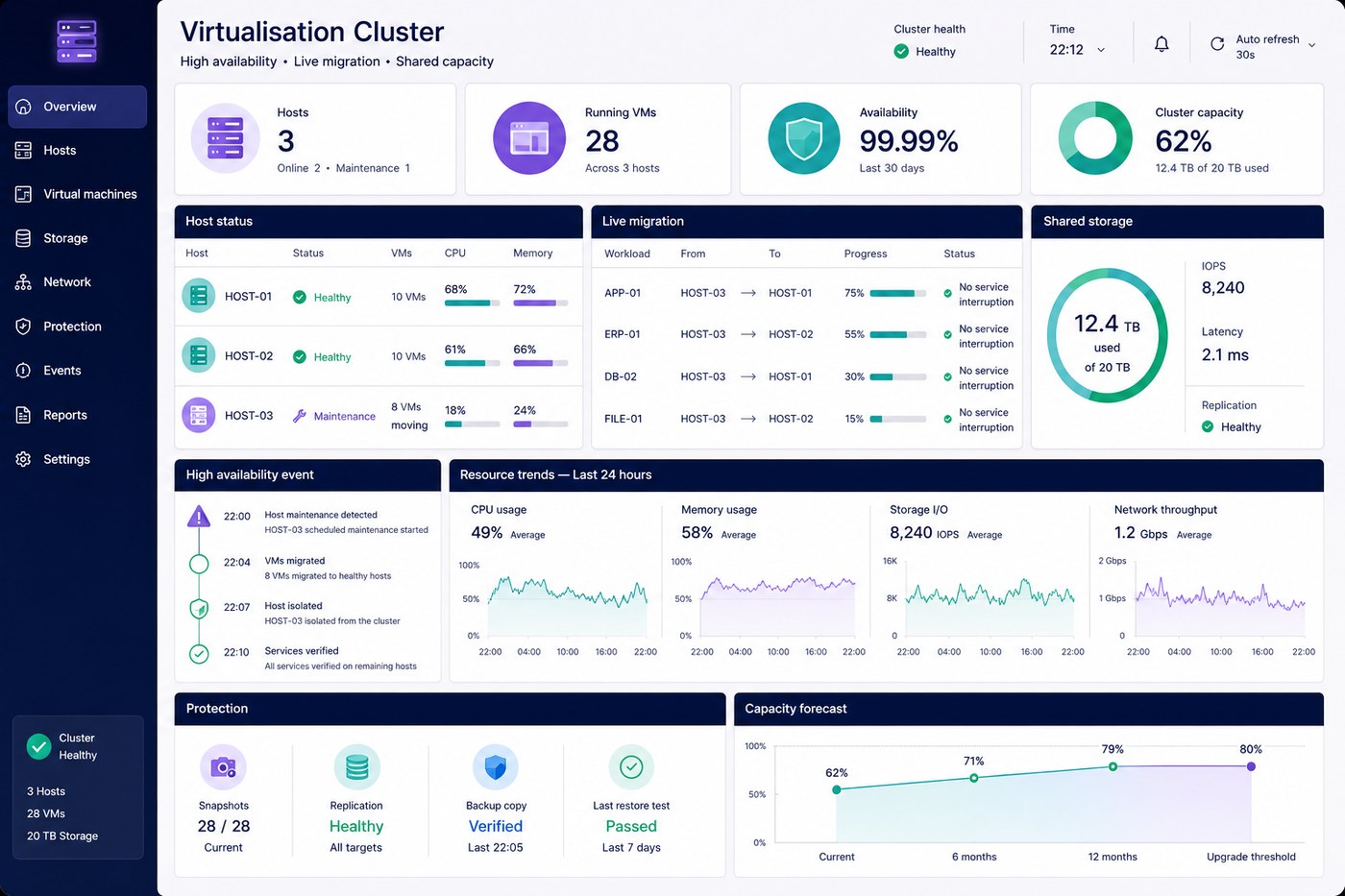
Virtualisation turns a rack of under-used servers into a small, resilient cluster: fewer boxes to buy, power and cool; a hardware failure that becomes a log entry instead of a night shift; and a snapshot taken before every risky change. The technology itself is settled. What is not settled, and what costs companies real money, is which platform to run it on.
We work across the three that matter here. VMware remains the enterprise standard and is still the right answer for some estates, though its licensing changes have redrawn the economics for many. Hyper-V ships inside the Windows Server licences most Windows-centric companies already hold. Proxmox VE is open-source, has matured into a serious cluster platform with backup and replication built in, and takes per-socket licensing out of the equation altogether, with a paid support subscription available when you want a vendor behind it.
The service is the same whichever you land on: we analyse the workloads, recommend a platform with the reasoning and a five-year cost written down, design and build the cluster, migrate in planned waves with a rollback window per workload, and keep the result patched, monitored and capacity-checked afterwards. Sometimes the honest recommendation is to stay exactly where you are, we say that too.
What the service includes
Platform choice, costed
VMware, Hyper-V and Proxmox compared against your actual workloads, existing licences and a five-year budget, with the reasoning written down rather than asserted.
Design & consolidation
Workload analysis and a cluster design that cuts the hardware count without cutting headroom, on the platform you chose.
Migration in waves
Physical-to-virtual, VMware-to-Hyper-V or VMware-to-Proxmox, planned workload by workload with a tested rollback window. No big-bang weekend.
High availability & recovery
Clustering, snapshots and replication configured so a dead host restarts its workloads automatically and a bad change is reversible in minutes.
Health checks & upgrades
Existing vSphere, Hyper-V or Proxmox environments reviewed, tuned and upgraded along tested rollback paths.
Ongoing management
Hosts patched, capacity and performance watched under the monitoring service, and your licensing position kept clear ahead of every renewal.
Why it pays off
- Fewer physical servers to buy, power and cool
- A hardware failure becomes a non-event rather than a night shift
- Snapshots make risky changes reversible in minutes
- A platform picked on your numbers, including the open-source option, where per-socket licensing disappears
- An honest licensing position ahead of every renewal
The return for your business
Consolidation returns money directly: in hardware not bought, licences not renewed, and downtime not suffered.
An illustration, not a past project
Seven ageing servers, and a renewal at several times last year’s price
A manufacturer ran seven physical servers, each a single point of failure and each past warranty, while facing a VMware renewal several times its historical price. We compared renewal, Hyper-V on licences they already held, and Proxmox, against their workload profile and a five-year budget. Hyper-V won on their numbers. Hardware was procured by the client against our specification and installed by their contractor under our supervision; workloads moved in planned waves over six weeks, each with a rollback window. When one host later lost a power supply, its workloads restarted on the second host in minutes, production never noticed.
Start with a conversation
An initial consultation with a consultant rather than a salesperson, about your IT, security or systems question.