
Data Classification & Analysis
Most organisations cannot answer three questions: what data do we hold, where is it, and who can see it? We answer them, then build the governance and analytics on top.
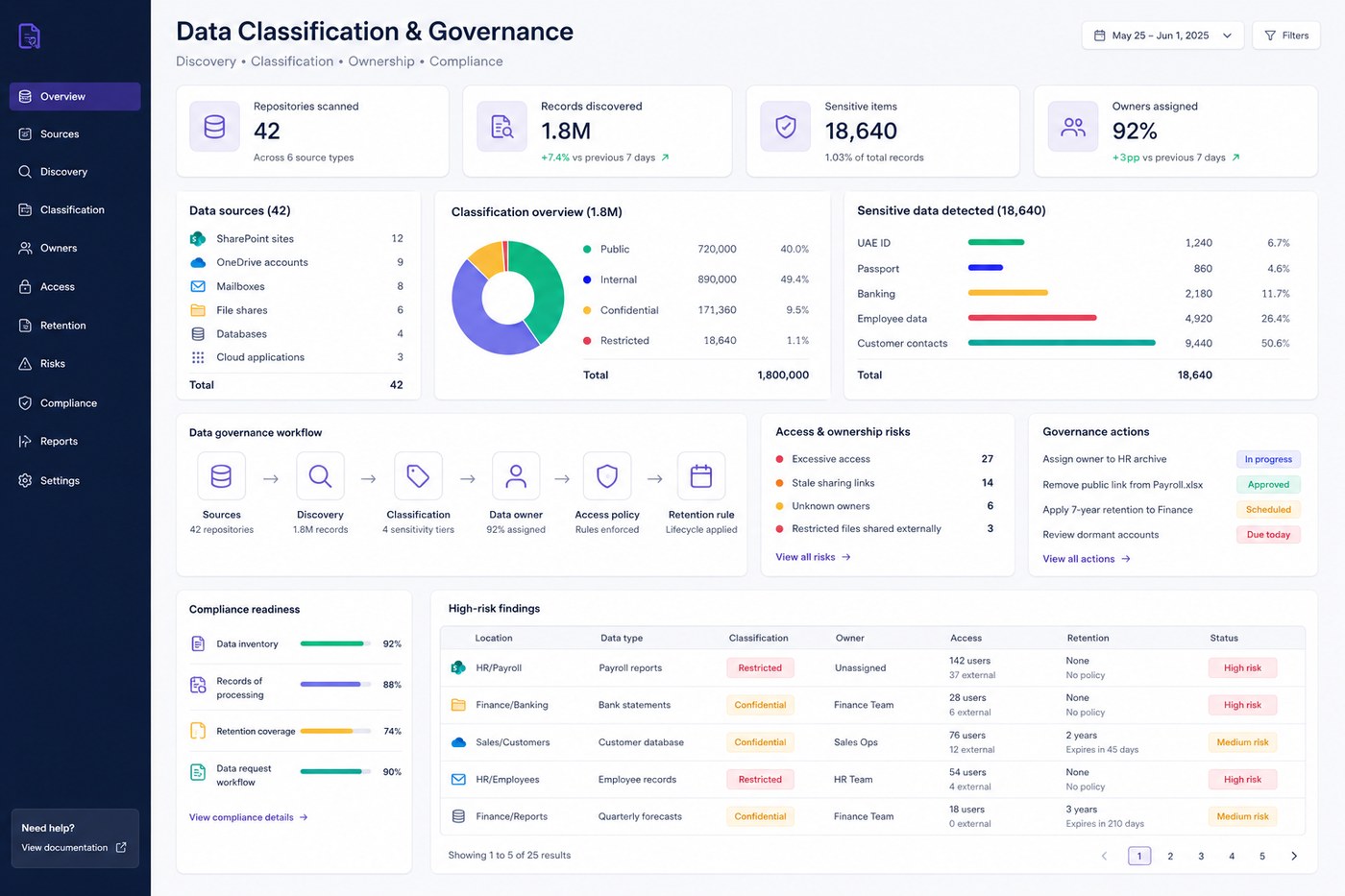
What is included
Data discovery & inventory
Automated scanning of file shares, mailboxes, databases and cloud storage; a register of what exists, where, and who owns it.
Classification scheme & labelling
A practical scheme (public / internal / confidential / restricted) mapped to UAE requirements, with automated labelling and DLP policies.
Data governance
Ownership, retention, access and quality rules with the tooling to enforce them, not a binder on a shelf.
Privacy compliance support
Records of processing, data maps, subject-request procedures and PDPL gap assessments (with your counsel).
Analysis & dashboards
Once data is trusted: KPI models, dashboards and predictive analysis for management decisions.
AI-assisted classification
Machine-learning classification for unstructured Arabic and English content at scale.
Platforms we work with
Consultancy first: recommendations come with reasons and alternatives, and we say when you do not need something.
How we deliver
Discover
Scan and interview; a factual inventory of your data estate.
Classify
Scheme agreed with legal and business owners; labels and DLP applied in waves.
Govern
Ownership, retention and access rules enforced through tooling.
Analyse
Dashboards and models on the now-trusted foundation.
What you can expect
- A data inventory and classification scheme in use, not on paper
- Access cut to who actually needs it, with evidence
- PDPL-ready records and procedures
- Dashboards on data whose lineage you can defend
What it changes for your business
Classification sounds like housekeeping until you see what it unlocks: faster audits, fewer people who can leak your prices, and dashboards management finally trusts.
An illustration
An illustration, not an account of a past project: a trading company of around 120 staff keeps price lists, customer contracts and HR files on one shared drive that everyone can open. Discovery maps the drive, the mailboxes and the ERP exports; the four-label scheme goes on in waves; access to commercial and HR data is cut to the teams that need it, with an approval trail. When a large customer sends a security questionnaire, or a PDPL query lands, the answers come from the register rather than from a panicked crawl through folders.
Frequently asked questions
Is this a legal compliance service?
We deliver the technical and organisational side: inventory, classification, controls, records. Legal interpretation stays with your counsel, with whom we work directly.
How long does a first classification take?
It depends on how many repositories are in scope, how quickly access is granted and how many exceptions the scheme has to carry. The timetable for your engagement is agreed in the proposal; labelling and DLP roll out in waves after the scheme is settled.
Does it work on Arabic documents?
Yes, our AI-assisted classification is evaluated specifically on Arabic and mixed Arabic-English content.
Do you need to copy our data out to analyse it?
No, we work inside your environment wherever possible. Where a copy is unavoidable it is agreed in writing, minimised, and destroyed at the end of the engagement.
Will classification slow our staff down?
Done properly, no: most labels are applied automatically, defaults are sensible, and staff only choose a label where the choice genuinely matters. The scheme is designed with your teams, then piloted on one department before it goes wide.
Start with a conversation
An initial consultation with a consultant rather than a salesperson, about your IT, security or systems question.