
Software & AI Systems Design
We architect and build the systems off-the-shelf products cannot cover: business platforms, AI assistants and models, integrations, and software for computer and communication equipment.
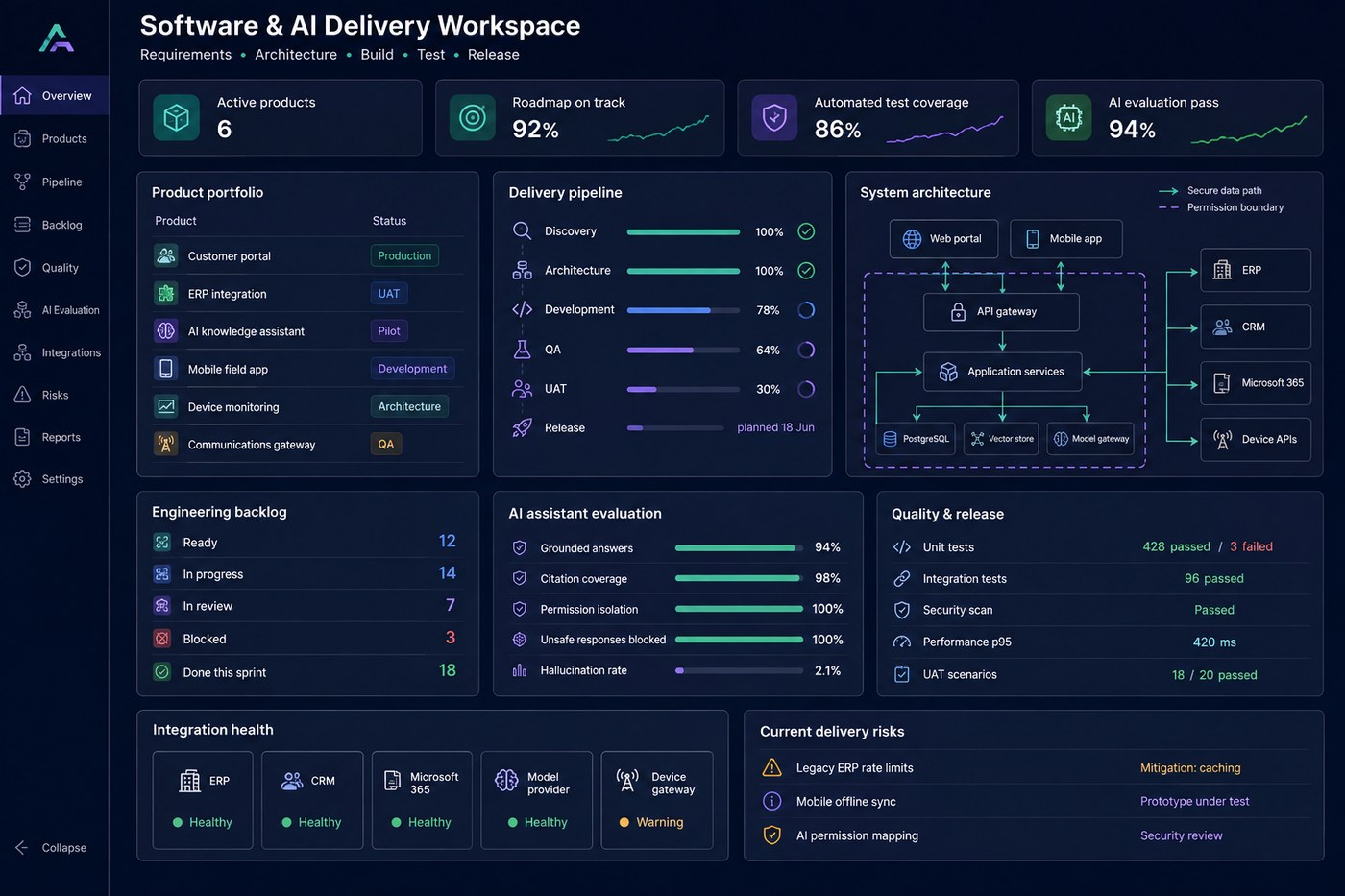
What is included
Product discovery & architecture
Requirements, UX prototypes and a written architecture with costs before code.
Websites, platforms & portals
Company websites, web platforms, customer portals and internal tools: designed, built and maintained, with authentication, payments and integrations.
AI systems
Retrieval-grounded assistants (Arabic and English), ML models for prediction and classification, agentic automation, with evaluation and governance.
Mobile applications
Native and cross-platform apps, published and maintained.
Systems & communication software
Software for devices, monitoring and management of communication equipment, and machine-to-machine integrations.
Quality assurance
Automated and manual testing, performance profiling and a security review of every release.
Platforms we work with
Consultancy first: recommendations come with reasons and alternatives, and we say when you do not need something.
How we deliver
Discover & design
Scope, UX and architecture agreed before anything is built. The fee, the delivery basis and the commercial terms for the first release are set out in the written proposal.
Build in sprints
A sprint rhythm set in the proposal, with demos and a staging environment you can use.
Test & launch
Automated tests, security review, performance testing, store submission where relevant.
Maintain & evolve
Support, monitoring and a roadmap under a maintenance agreement.
What you can expect
- Software that matches how you work, documented and owned by you
- AI answering from your data with citations, respecting permissions
- Integrations that stop the re-typing between systems
- A maintenance path so nothing decays
What it changes for your business
Custom software earns its cost in one of two ways: it removes hours of re-typing and chasing between systems, or it lets you offer something competitors on packaged products cannot. We design for one of those outcomes explicitly, and say so when neither applies.
An illustration
An illustration, not an account of a past project: a distributor quotes from an ERP, a price file and a salesperson’s memory. Each quote takes a day and errors surface after signature. Discovery maps the real rules; a quoting portal is designed on top of the ERP with the price logic encoded, approval steps, and an AI assistant that drafts the commercial text in Arabic and English. Quotes go out the same day, the error rate is visible in a dashboard, and the sales team stops re-typing what the ERP already knows.
Frequently asked questions
Who owns the code?
The proposal defines it before you sign: ownership, licence rights, source-code handover and documentation are each written into the agreement for the engagement, including how any third-party or open-source component is licensed. We write it down rather than leave it to be argued about later.
What about ERP implementations?
We work on ERP environments and the systems already running beside them: development, customisation, integration, automation and improvement. We do not build a complete ERP platform from scratch. What that means for your engagement, and on what terms, is set out in the proposal rather than promised here.
Will our data be used to train public models?
It depends on the platform, the tier, the configuration and the contract. We identify those terms in the proposed architecture before implementation, and where exclusion from training is required it is written into the proposal and verified against the provider’s current terms.
Can you take over software someone else built?
Yes, after a short technical review so we can tell you honestly what state it is in and what taking it on will cost. Sometimes the answer is to stabilise and extend; sometimes it is cheaper to rebuild one piece at a time, we show you the comparison.
How do you keep a project from dragging on?
A first release with a written scope, a delivery rhythm and demo cadence set in the proposal, and a rule we enforce on ourselves: scope changes are priced and agreed in writing before they are built, never absorbed silently until the deadline slips.
Start with a conversation
An initial consultation with a consultant rather than a salesperson, about your IT, security or systems question.