
Use Cases
The fastest way to understand how we work is to walk through a project. Here are three realistic briefs, what they actually require, where they usually go wrong, and exactly who does what.
A complete office for 35 people, from bare shell to first login
Walk through this scenario Real estateBuilding the whole IT foundation for a 90-person real-estate company
Walk through this scenario ManufacturingGiving a factory management real-time production visibility
Walk through this scenarioThese are worked scenarios, not client case studies: the numbers describe the scenario so you can map it to your own. Client references are shared in conversation, with permission.
A complete office for 35 people, from bare shell to first login
The brief
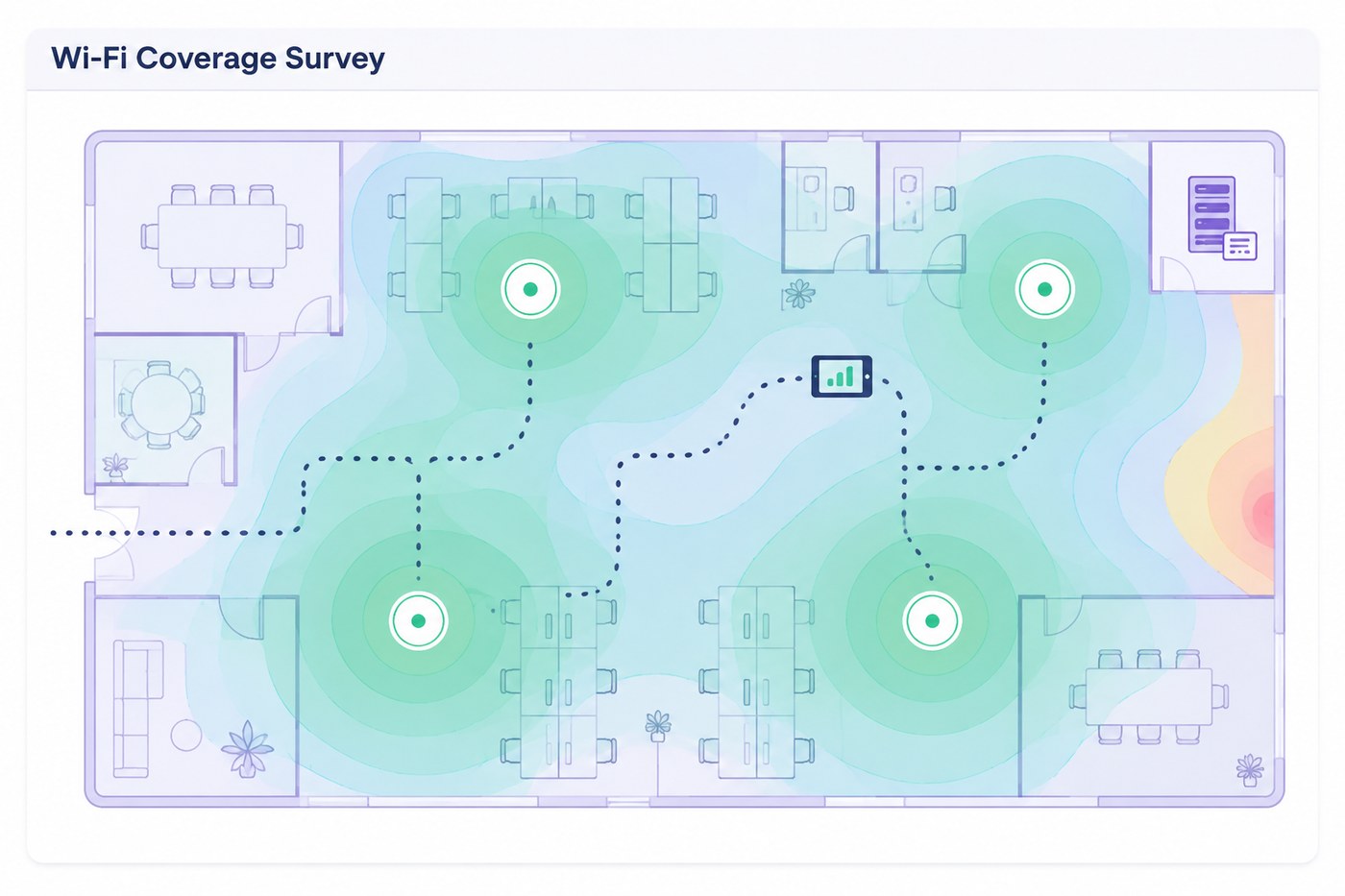
A company signs the lease on a bare-shell office for 35 staff, moving in eight weeks. Today “IT” is one line on the fit-out contractor’s quote with no detail behind it: no network design, no server room plan, no idea what to buy or what it should cost.
The brief to Vega Sky: make this office work on day one, network, Wi-Fi, security, meeting rooms, printers, identity, without us selling a single box or pulling a single cable, we advise and engineer, suppliers and contractors sell and install, and that separation is what keeps the advice independent.
An illustrative scenario, not a delivery commitment or a past project.
What the project actually needs
- A floor-plan-based design: around 80 cabling drops, Wi-Fi coverage with no dead corner, a cooled and lockable network room
- A full bill of materials (switches, firewall, access points, UPS, rack) with alternatives at two price points
- Segmentation from the start: staff, guest, printers/IoT, meeting rooms, CCTV on separate networks
- Identity and device baseline: Microsoft 365 tenant, single sign-on, laptops enrolled and encrypted before handout
- Meeting rooms that start a call in one touch, and a printer that just prints
- Documentation and monitoring from the first day, not reconstructed later
Where projects like this go wrong
The quote hides the network
Fit-out contractors price “data points” by count, not by design. Without a specification, you get the cheapest cable, no testing certificates, and access points wherever the ceiling was easiest.
Lead times bite last
Firewalls and switches can take weeks to arrive. Ordered late, after the walls are painted, they become the reason the move-in slips.
Everything lands in week eight
Cabling finishes, furniture arrives, internet activation and staff onboarding all collide in the final week. Without one plan and one owner, day one becomes week three.
Security is bolted on later
Offices built “to get people working” keep flat networks and shared passwords for years. Retrofitting segmentation into a live office costs multiples of designing it in.
How we run it
Week 1–2 · Survey & design
Floor-plan review, requirements workshop, predictive Wi-Fi survey. Output: the network design, the room layout and the bill of materials your suppliers can price.
Week 2–3 · Tender & order
Cabling scope priced by your fit-out contractor against our specification; hardware ordered by you from any supplier. We compare the quotes and flag the padding.
Week 3–6 · Works under supervision
The contractor pulls and terminates cabling to the spec; we inspect, review test certificates, and prepare configurations off-site while the paint dries.
Week 6–7 · Configure & commission
Our engineers configure switches, firewall, Wi-Fi and identity, enrol the laptops, and test every drop, every AP and every meeting room against the acceptance checklist.
Week 8 · Move-in & handover
Staff log in on day one. You receive the as-built documentation, credentials in a vault, monitoring live, and an optional managed-network agreement.
What Vega Sky does
- Design, bill of materials and tender comparison
- Supervision of cabling works and certificate review
- All configuration: network, security, Wi-Fi, identity, devices
- Acceptance testing, documentation, monitoring, handover
What your contractor & suppliers do
- Fit-out contractor: cabling, containment, rack mounting, power
- Your chosen suppliers: hardware and software procurement
- ISP: internet circuits (we specify and chase)
- Landlord/MEP: network-room cooling and power provision
What “done” looks like
- Every desk, room and device working on day one: verified against a checklist, not assumed
- A segmented, documented network with monitoring already running
- Procurement done at market price from your suppliers, against a spec that prevented over-buying
- One accountable consultancy, and a paper trail for every decision
Practices involved: IT Network Services · Cyber Security Consultancy
Building the whole IT foundation for a 90-person real-estate company
The brief
A real-estate company runs a head office and three site offices across sales, leasing and property management. It grew faster than its IT. Agents work from personal laptops and personal mail, client documents travel by WhatsApp, one Wi-Fi password is known to every visiting broker, the printer scans title deeds into a folder anyone can open, and listings, renewals and commissions live in spreadsheets only one person fully understands. Meanwhile three vendors are pitching three different ERP products to management.
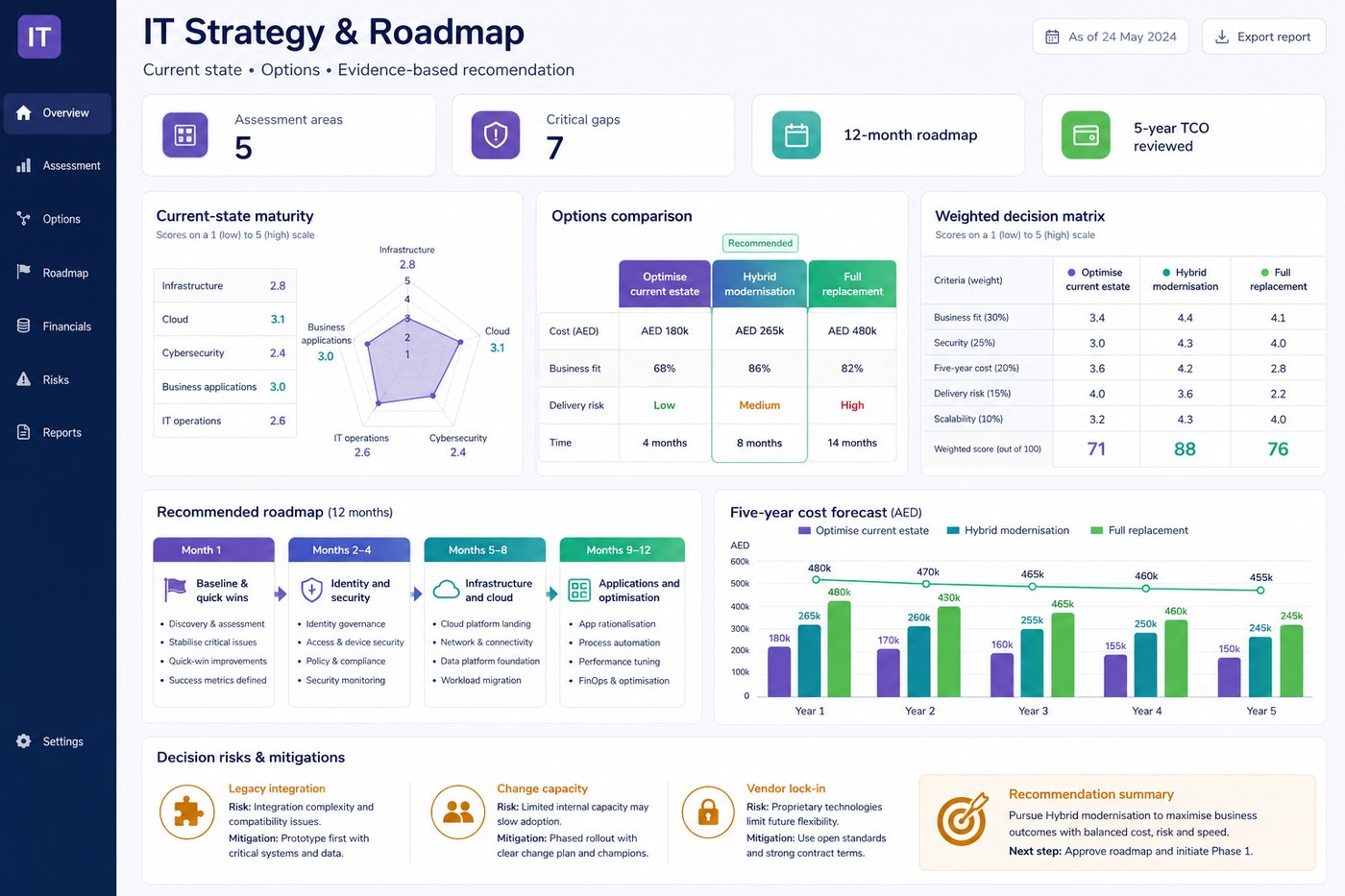
The brief to Vega Sky: build the foundation properly, identity, devices, network and printing, automate the paperwork that eats the admin day, and turn the ERP question into a decision management can defend.
An illustrative scenario, not a delivery commitment or a past project.
What the project actually needs
- A Microsoft 365 tenant built to a design: one identity per person, multi-factor authentication for everyone, conditional access, and licensing sized to the roles rather than to the sales pitch
- Every laptop enrolled, encrypted and patched, and a documented answer for a device lost on a site visit
- Company data protected on the agents’ own phones without taking their phones over
- A network and Wi-Fi design covering the head office and the three site offices, with staff, visiting brokers, printers and CCTV kept apart
- Printing and scanning that files a scanned document into the right client folder with a permission behind it, instead of into an open share
- The repeating paperwork automated: listing approvals, tenancy renewals, commission sign-off and document-expiry reminders
- An ERP decision made on written requirements for sales, leasing, property management and finance, with the integration designed before signature
Where projects like this go wrong
The tenant already exists, which is harder
Microsoft 365 was bought years ago as mailboxes and nothing behind the mailbox was ever configured: the admin account is shared by three people, leavers still hold licences, and no policy has ever been applied. Rebuilding a live tenant while people work inside it takes more care than starting from nothing, which is exactly why it keeps being postponed.
The phone is the office
Agents run their day from a personal phone at a viewing. Lock it down like a company laptop and the work moves back to WhatsApp and personal mail within a week. The design has to protect company documents inside the apps that hold them and leave the rest of the phone alone.
The demo is not the ERP
Every vendor demonstrates the module that works. Commission structures, post-dated cheque schedules, tenancy renewals and handover snags are where property systems actually break, so those go into the scoring and get tested against your own numbers rather than the demo data.
Automating a process nobody has agreed
An approval flow built before the business decides who approves what only makes the argument faster. Each automation starts with the decision written down and a named owner, and is built after that, not before.
How we run it
Weeks 1–2 · Survey & design
Audit of the tenant, the devices, the network at every office and the paperwork that repeats. Output: the design, the licence plan and a bill of materials your suppliers can price.
Weeks 2–4 · Tenant & identity
The tenant rebuilt to the design: one identity per person, multi-factor authentication, conditional access, a joiner and leaver process, mail security, and a document structure for listings, tenancies and client files with permissions behind it.
Weeks 4–6 · Devices, network & print
Laptops enrolled, encrypted and patched; company data protected on personal phones; the network segmented and Wi-Fi rebuilt at the head office and the three site offices; printing and scanning secured with release at the device.
Weeks 6–9 · Automate the paperwork
Listing approvals, tenancy renewals, commission sign-off and expiry reminders built as flows, piloted with one team, then rolled out. Every flow has a named owner and a way to stop it.
Weeks 8–12 · ERP selection & design
Requirements written with the department heads, three candidates scored against them, shortlisted demos run on your own data, and the integration design handed over: which system owns which record, what moves where, and what stays manual on purpose.
What Vega Sky does
- Tenant, identity and licence design, and the configuration behind it: conditional access, mail security, document structure
- Device enrolment, encryption and mobile protection; network, Wi-Fi and print design and configuration across the four offices
- Automation of the approvals and reminders, built and piloted with the teams that use them
- ERP requirements, scoring, supervision of the shortlist demos, and the integration design
What your contractor & suppliers do
- Your suppliers: hardware, licences and the ERP contract, bought at market price against our specification
- Your cabling contractor: containment, drops and rack work at the site offices
- The ERP vendor: implementation and configuration of their own product, to the design we hand over
- Department heads: the decisions only the business can make, commission rules, approval limits, retention
What “done” looks like
- One identity per person with multi-factor authentication and a joiner and leaver process, in place of shared logins and licences for people who left
- Every laptop encrypted and enrolled, and company data on a personal phone that can be removed without touching anything else on it
- Client documents in one structure with permissions behind them, scanned straight from the printer into the folder they belong in
- An ERP chosen on written requirements, with the integration designed before signature rather than discovered after the first invoice
Practices involved: IT Network Services · Cyber Security Consultancy · Software & AI Systems Design
Giving a factory management real-time production visibility
The brief
A manufacturer runs three production lines across a plant and a warehouse. Output numbers reach management as an Excel file on the 5th of the following month, typed from paper log sheets. Machine stoppages are argued about from memory. The plant network is one flat cable-run grown over a decade: the office, the CCTV and the machine controllers all see each other.
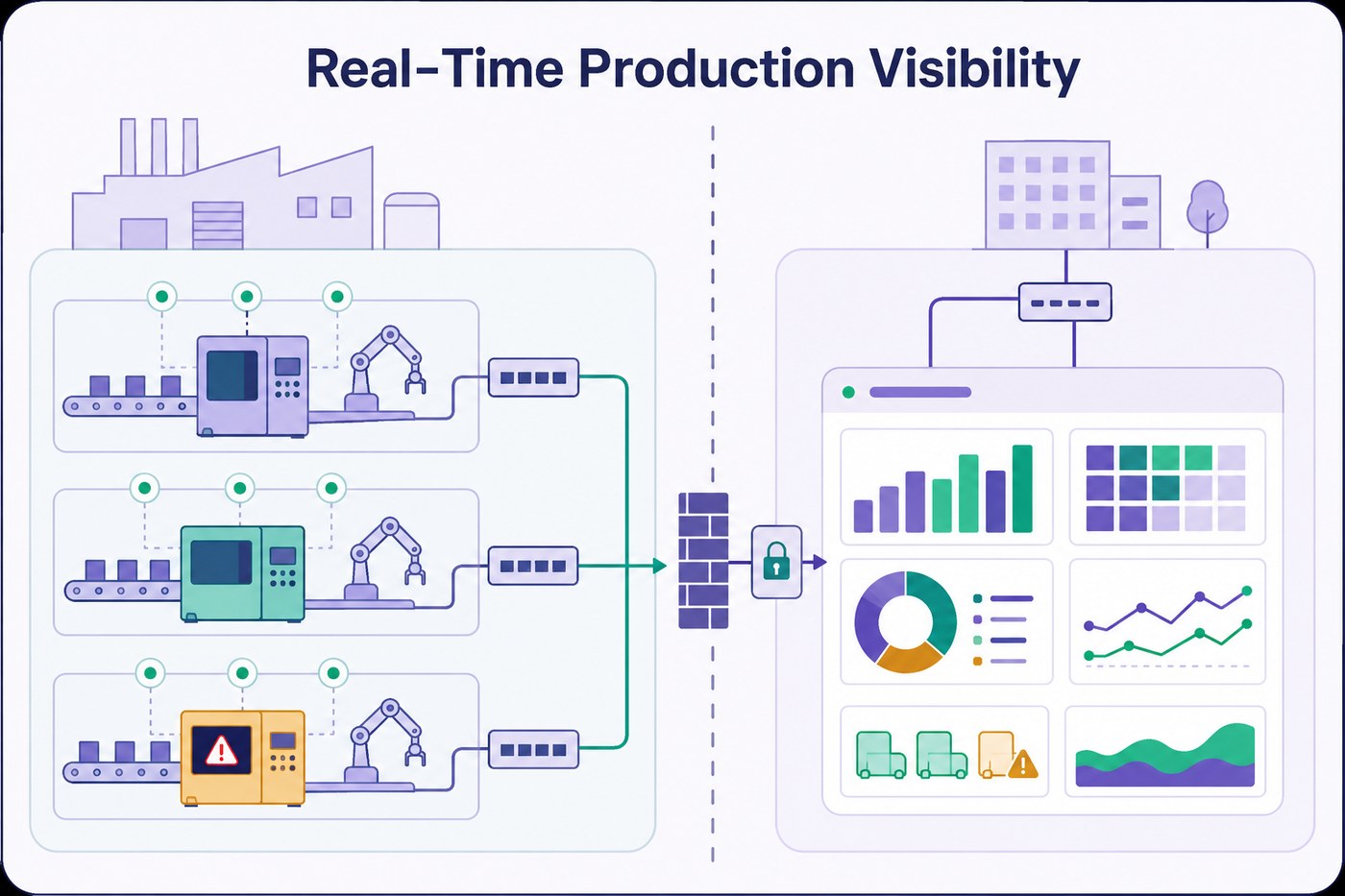
The brief to Vega Sky: management wants live production numbers on a screen, and the audit-minded CFO wants the machine network separated from the office before something crosses over.
An illustrative scenario, not a delivery commitment or a past project.
What the project actually needs
- A survey of what the machines can actually report (PLC outputs, counters, existing sensors) before promising any dashboard
- A redesigned plant network separating office IT from machines and CCTV, with industrial switches specified for the floor
- Data collection from the lines into one store, bridged safely across the OT/IT boundary
- Dashboards for three audiences: the line supervisor, the plant manager, the owner
- Wi-Fi that survives a steel-and-concrete hall for scanners and tablets
- A security review of every remote-access path machine vendors have quietly installed
Where projects like this go wrong
The machines speak twelve dialects
One line has a modern PLC with OPC UA, another counts via a retrofit sensor, the third only knows what the operator writes down. The design has to take each line as it is: a phased rollout, not a big bang.
You cannot reboot a production line
Network changes on the floor happen in maintenance windows, with the line’s own engineer present and a rollback rehearsed. The schedule belongs to production, not to IT.
Vendor remote access is the open back door
Machine vendors install their own routers and TeamViewer boxes “for support”. Finding and closing these without breaking support contracts is a negotiation, not just a firewall rule.
A dashboard nobody trusts is decoration
The first weeks always surface gaps between the counter and the paper log. The rollout includes a reconciliation period where both run side by side until the numbers earn trust.
How we run it
Weeks 1–3 · Plant survey
Walk the floor with production and maintenance: machine inventory, what each can report, network as found, every remote-access path listed. Output: a phased design and an honest statement of what line 3 cannot do without a sensor retrofit.
Weeks 3–6 · Network first
Segmented design: office, machines, CCTV, vendors each in their zone. Industrial switches and cabling specified; installation by your electrical contractor in maintenance windows, configured and commissioned by our engineers.
Weeks 5–9 · Data collection
Collectors deployed line by line across the OT/IT boundary; readings landing in one store with the ERP order numbers joined on. Line 3 starts with a tablet form at the station, honest data beats fake automation.
Weeks 8–12 · Dashboards & trust
Supervisor, plant-manager and owner views built and reconciled against the paper logs until they match. Then the paper stops. Vendor remote access re-issued through one controlled gateway.
What Vega Sky does
- Survey, phased design and the industrial bill of materials
- All network, collector and dashboard configuration
- Security review and the vendor remote-access gateway
- Reconciliation, documentation and handover to maintenance
What your contractor & suppliers do
- Your electrical contractor: floor cabling and cabinet works in maintenance windows
- Machine vendors: PLC access details and support-contract cooperation
- Your suppliers: switches, sensors and server procurement against our spec
- Production team: the maintenance windows and the paper log during reconciliation
What “done” looks like
- Live production numbers per line, on a screen, the same day, with a lineage you can defend
- Machine network separated from office and CCTV; an incident in one zone stays in one zone
- Every vendor back door replaced by one gateway with logging
- Monthly reporting that starts from data, not from typing
Practices involved: IT Network Services · Software & AI Systems Design · Data Classification & Analysis · Cyber Security Consultancy
Your project will not match these exactly
That is fine, none of our clients’ do either. Describe yours in an initial call and we will tell you what it actually requires, and what we would not do.