
Managed IT or an in-house hire: how to compare them on your own numbers
Every growing company hits the same question: hire an IT person, or sign a managed agreement? There is no headcount at which one of them starts winning, so this sets out what belongs on each side of the comparison and gives you a calculator that uses your figures rather than ours.
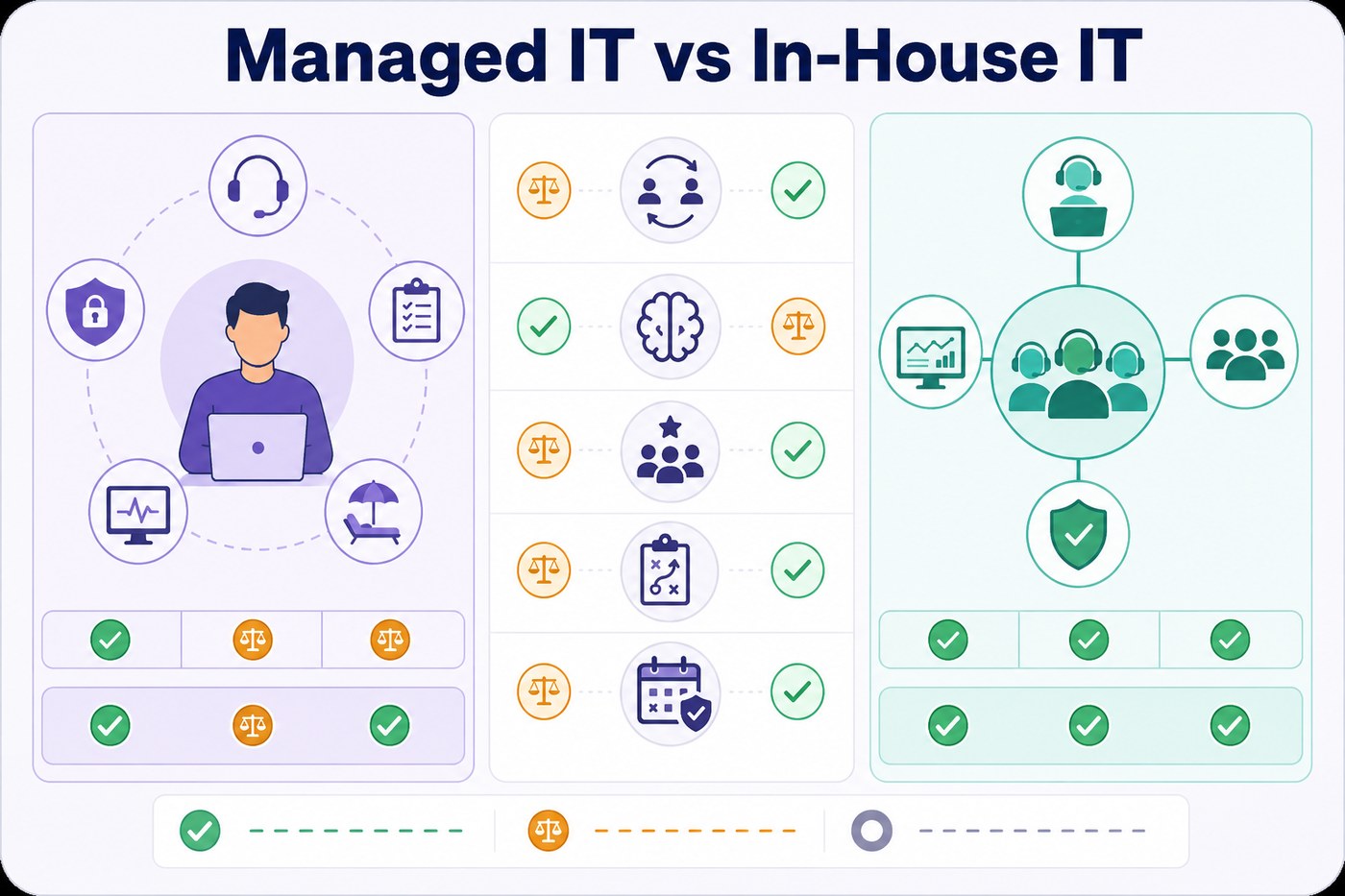
Somewhere between fifteen and fifty staff, every company has the same argument: the “IT guy who comes when things break” is clearly no longer enough, so do we hire someone, or sign a managed IT agreement? Both sides of that argument usually come armed with feelings. Here are the factors that actually decide it.
What an in-house hire really costs
The salary is the visible part. The rest is real but it is yours to count, not ours to assume: recruitment and onboarding, work permit and visa, health insurance, allowances, training and certifications, end-of-service accrual, and the tooling one person needs, since monitoring, ticketing and backup platforms are priced for fleets rather than individuals. What each of those costs depends on the person, the contract and the employer, which is why the calculator below asks you for them instead of applying a percentage.
One thing is worth stating precisely, because it is where this comparison is most often got wrong. Annual leave in the UAE is paid: article 29 of Federal Decree-Law No. 33 of 2021 provides annual leave on full wage. So leave does not reduce the salary bill to eleven months. You pay twelve either way. What leave changes is availability, not payroll, and if covering that absence would cost you something, that cover is its own number rather than a discount on the salary.
Then there is the structural point, which no amount of arithmetic settles. One person cannot be on call 52 weeks a year. Annual leave, sick days and a resignation letter are all single points of failure with your company’s uptime attached.
What a managed agreement really costs
A recurring fee, scoped in the agreement that sets it, which bundles the monitoring platform, the patch discipline, the helpdesk and the escalation bench. The catch to watch for is scope: cheap agreements are cheap because they exclude the things you will actually need. On-site visits, projects, after-hours work. Read the SLA, not the price.
Where the break-even actually falls
There is no headcount at which one option starts winning. We are not going to print one, because the number would depend on figures we do not have: what you would actually pay an employee beyond salary, what tooling you would buy, what a managed agreement quotes you, and what that quote covers. Run the calculator below on your own figures and the arithmetic will tell you which way your case falls. It may fall either way, and at any size.
What the arithmetic will not tell you is whether the two things being compared are the same thing, and usually they are not. A quote that excludes site visits, projects and out-of-hours work is cheaper than one that includes them, and cheaper than an employee who does all three. So read the scope before the price, on both sides.
The answer is also not always one or the other. Co-management is a third shape: an internal person who knows the business, with external monitoring, escalation and cover behind them. One arrangement is worth naming separately because it is not really a model at all, which is a single hire carrying everything with no tooling, no cover and nobody to escalate to. That is an under-resourced version of the in-house option rather than an alternative to it, and it is worth checking that it is not what you are actually costing.
The questions that decide it
Ask yourself four things. Can we tolerate a week of degraded IT while a hire is on leave? Do we have anyone able to interview an IT candidate technically? Is our need mostly daily support, or mostly projects? And who watches the systems at 2 a.m.? Your answers may point to an in-house, managed or co-managed model. Compare the calculator result with the actual responsibilities, coverage, exclusions and escalation terms in the job description and the written proposal before deciding.
The bottom line
Do not frame it as either/or. Frame it as: which layers of IT does the business need, and what does covering each layer cost under each arrangement you are actually being offered? The first question is about your business and nobody outside it can answer it. The second is arithmetic, and the calculator above does it on your figures. If you want the comparison run with us in the room, get in touch and we will agree in writing what that work involves before any of it starts.
In-house hire or managed agreement, on your figures
Every amount below is one you supply. Nothing is assumed for you, there are no percentages working behind the boxes, and the arithmetic is printed under the result so you can check the total on a calculator.
Everyone who would raise a ticket, not only the people at desks.
The gross monthly salary you would write into the contract.
AEDOne yearly total for whatever you would actually pay on top of the salary: recruitment and onboarding, work permit or visa, health insurance, allowances that are not already inside the salary above, training and certification, and end-of-service accrual. If an allowance is already inside that salary, do not count it twice. Enter 0 if there is nothing to add.
AEDOnly what you would buy because the work is done in-house: monitoring, ticketing, remote access, a backup console. Anything you would pay for under either option belongs on neither side of this comparison. Enter 0 if there is nothing.
AEDWhat you would spend in a year on covering absence, if you would spend anything. Annual leave is paid, so it is already inside the twelve months of salary above: this box is for the cover, not for the leave. Enter 0 if you would not buy cover.
AEDA figure you have already been quoted or have budgeted. We do not publish a rate. This box accepts 200 or more so that an obvious slip of the keyboard does not quietly produce a result; that floor is a limit on what the calculator will accept and is not a price, a package or a starting point of ours.
AEDIndicative only, and built entirely from figures you enter. We do not publish a rate for a managed agreement: ours is set after we understand what you need and arrives as a written proposal, so the last box is for a figure you have already been quoted or have budgeted. This is not legal, payroll or accounting advice.
Start with a conversation
An initial consultation with a consultant rather than a salesperson, about your IT, security or systems question.