
AI assistants on your own company data: what actually works in 2026
Everyone has tried the public chatbots; the real value is an assistant that knows your contracts, your prices and your procedures, without leaking them. What works, what disappoints, and where to start.
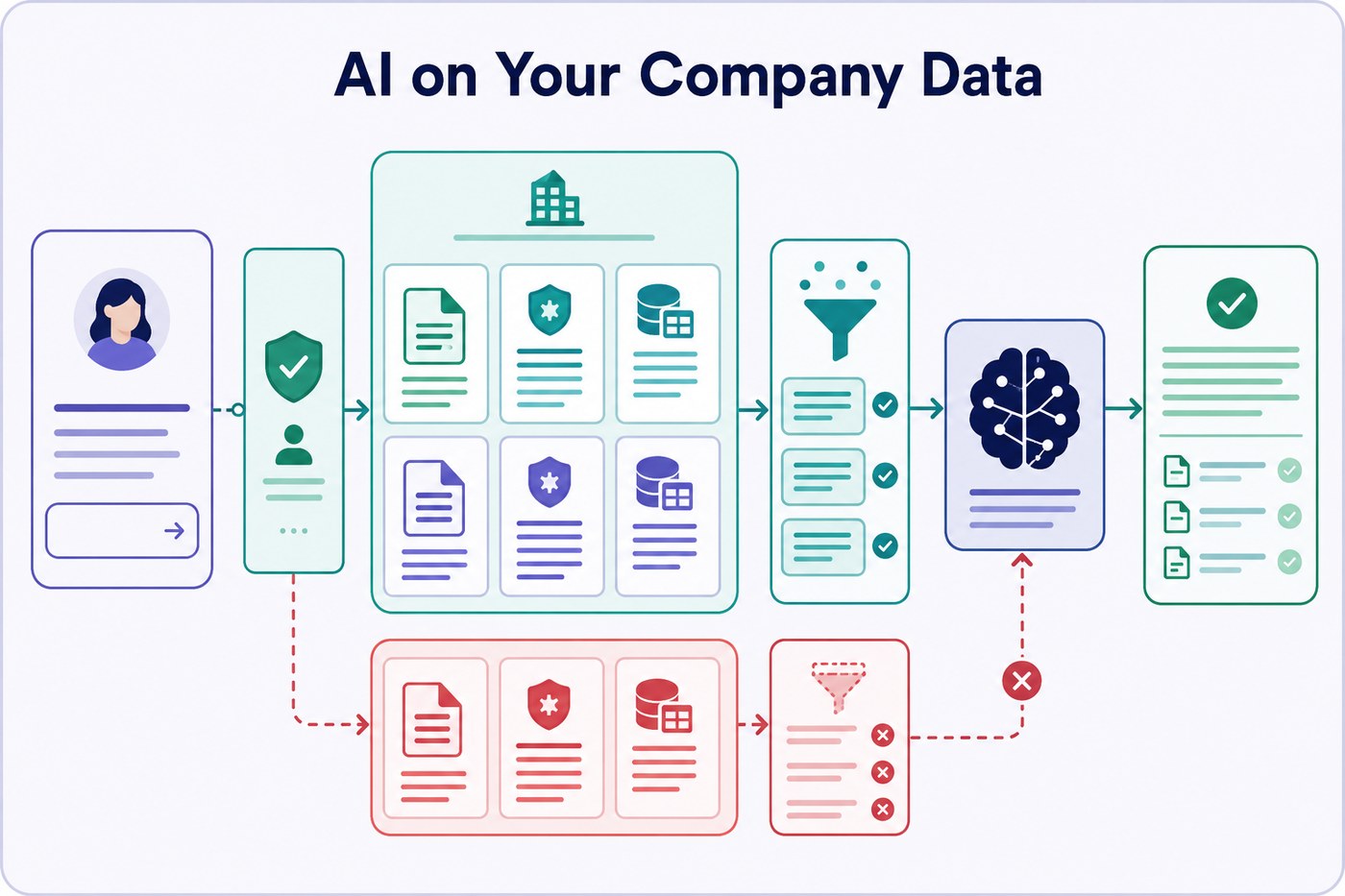
The gap between “we tried ChatGPT” and “our team has an assistant that answers from our own documents” is where the real business value of AI sits in 2026. The first is a toy with a confidentiality problem. The second is a colleague who has read everything your company ever wrote and never gets tired. Getting from one to the other is an engineering project, a well-understood one.
How it works, in one paragraph
The pattern is called retrieval-augmented generation: your documents stay in your storage; when someone asks a question, the system retrieves the relevant passages and hands them to the model, which answers from those passages, with citations. The model does not memorise your data, whether your data is excluded from training depends on the platform, the tier and the contract you are on, and every answer can show its sources, which is what makes staff trust it.
What it is genuinely good at
Answering policy and procedure questions instead of interrupting a manager. Finding the clause across two hundred contracts. Drafting the first version of an offer, a job description or a client reply in your house style, Arabic and English. Summarising the 40-page tender by tomorrow’s meeting. In each case the pattern is the same: the knowledge existed, but finding it cost more than it should.
What still disappoints
Assistants built on messy data answer messily, if three versions of the price list live in three folders, the assistant will faithfully cite the wrong one. (This is why data classification and AI are one conversation, not two.) Fully autonomous “agents” doing multi-step work unsupervised are still a risk appetite question, not a default. And any tool that requires uploading your documents to an unknown vendor’s cloud deserves the security review it almost never gets.
The permission problem nobody mentions
The hardest requirement is not intelligence, it is that the assistant must respect who is allowed to see what. HR questions answered from HR files must not be answerable by everyone. A proper build inherits your existing permissions, so the assistant knows less for some users, exactly as it should.
Where to start
Not with a platform decision: with one painful, bounded use case: the support inbox, the tender library, the policy questions. Build it in weeks on your own data, measure whether people actually use it, then expand. The companies disappointed by AI almost all started with a big platform and no use case; the satisfied ones started with one question their staff asked every day.
Retrieval, working, on a sample handbook
This is the half of an AI assistant that decides whether it can be trusted: retrieval. Ask a question and watch it find the passages that answer it, then quote them with their source. No model, no network call, the point is to show where the answer comes from.
A demonstration of the retrieval step only. A production assistant adds a language model to phrase the answer, and, the part that matters most, inherits your existing permissions so it knows less for people who are allowed to know less.
Start with a conversation
An initial consultation with a consultant rather than a salesperson, about your IT, security or systems question.