
Website, web app or mobile app? What to build in 2026, and where projects go wrong
Everyone agrees the company needs “an app”. Which kind (a proper website, a web application, or a native mobile app) changes the budget by an order of magnitude. A plain-language guide to choosing, with the traps marked.
“We need an app” is the most expensive vague sentence in business technology. Depending on what it turns out to mean, it costs somewhere between a few thousand dirhams and a few hundred thousand. Before any developer quotes you, the real question needs answering: what are you actually building, for whom, and why?
The three different animals
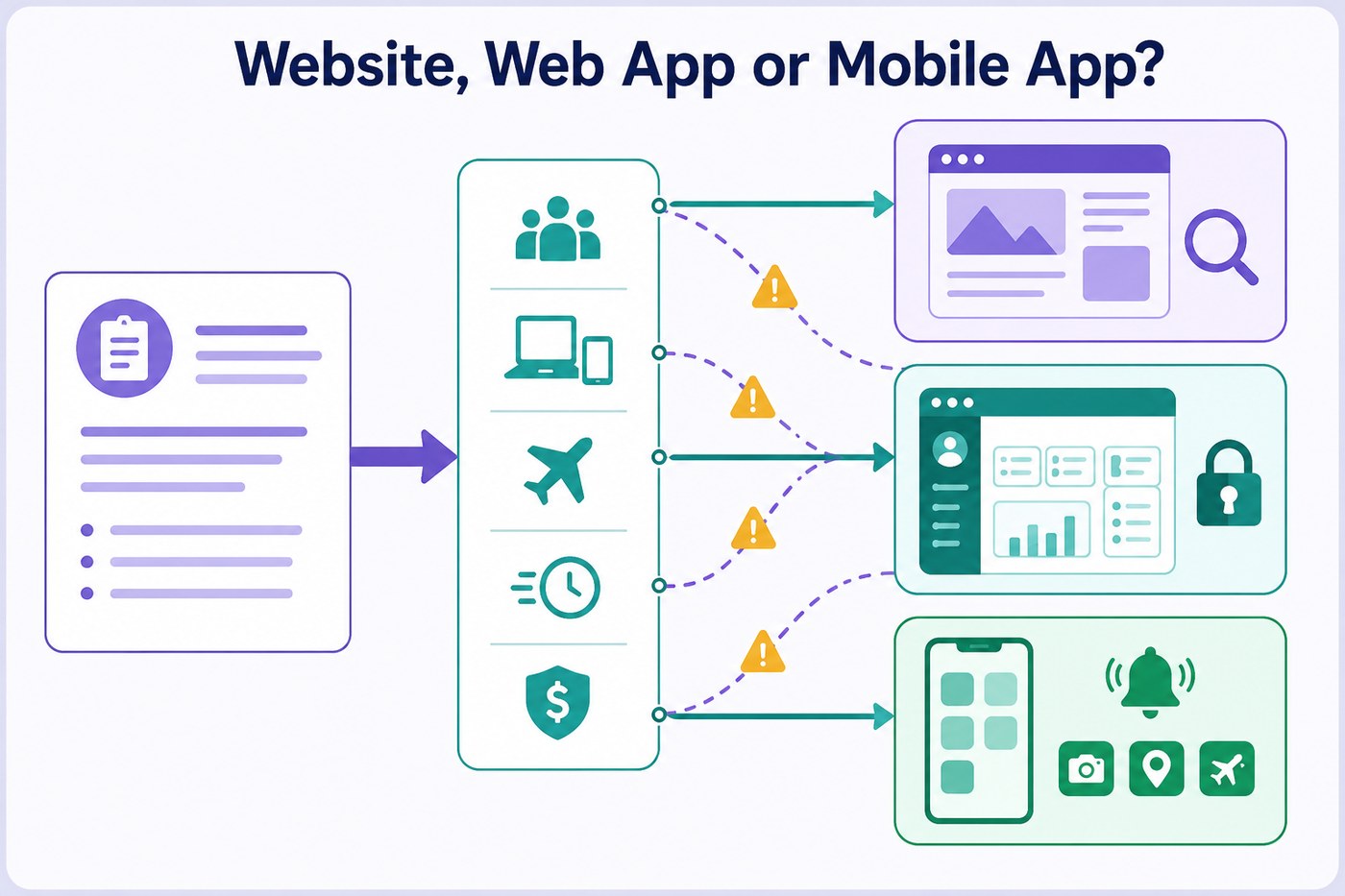
- A website presents: who you are, what you sell, how to reach you. Its job is to be found, load fast, and convert a visitor into a call or an order.
- A web application does work: portals, dashboards, booking systems, internal tools. It lives behind a login and runs in the browser on any device.
- A mobile app lives in the stores and on the home screen. It earns its place only when you need what phones uniquely offer: push notifications, camera, GPS, offline use, or daily-habit presence.
The decision in one paragraph
Start with the website, every business needs one and it anchors everything else. Build a web application when users need to do things, not read things; it works on every device from day one, needs no store approval, and updates instantly. Add a native mobile app only when push, offline, sensors or home-screen habit are genuinely part of the value, “our competitor has one” is not a reason; their download numbers would embarrass them.
Native vs cross-platform, honestly
If you do need a mobile app, you rarely need two separate native codebases anymore. Cross-platform frameworks (Flutter, React Native) deliver one codebase serving iOS and Android instead of two separate ones, with performance a business user cannot tell apart. What that saves depends on the application; the saving is in building and maintaining one codebase rather than two. Pure native still wins for games, heavy graphics and deep hardware integration, cases most businesses never touch.
What actually determines the budget
Not the platform, the scope. Logins, payments, Arabic/English with proper RTL, integrations with your ERP, an admin panel: each is real work whichever route you choose. The discipline that keeps budgets sane is a release-one scope that fits in months, agreed in writing with its commercial terms before the work starts, and everything else in a roadmap rather than in the first contract.
The traps, marked
Trap one: building a mobile app when a web application was the need. Doubling cost for an app nobody installs. Trap two: the beautiful website with no analytics, no speed budget and no SEO basics. Invisible and slow. Trap three: source code that stays with the agency; insist, in the contract, that code and documentation transfer to you. Trap four: no maintenance plan. Software without an owner decays in browsers and app stores alike. Every one of these is avoidable in the design phase, which is exactly why designing before building is the whole game.
What are you actually asking for?
Tick what the product genuinely needs. The estimate moves because each of these is a real body of work, not a checkbox, and seeing that is usually more useful than the number itself.
The assumptions, stated so you can argue with them: a four-week base for any release, the weeks shown against each tick added together, then a range of 85% to 135% around that total, for a small dedicated team working without interruption. It excludes discovery, design iterations and your own approval cycles. It is a way of seeing what you have asked for, not a quotation, not a price and not a delivery commitment. Duration and cost for real work are set after we understand the scope, and both arrive in a written proposal.
Start with a conversation
An initial consultation with a consultant rather than a salesperson, about your IT, security or systems question.