
Seven warning signs your office network will fail this year
Networks almost never fail without warning, the warnings just go unread. Seven signs we see in almost every assessment, what each one means, and which ones should genuinely worry you.
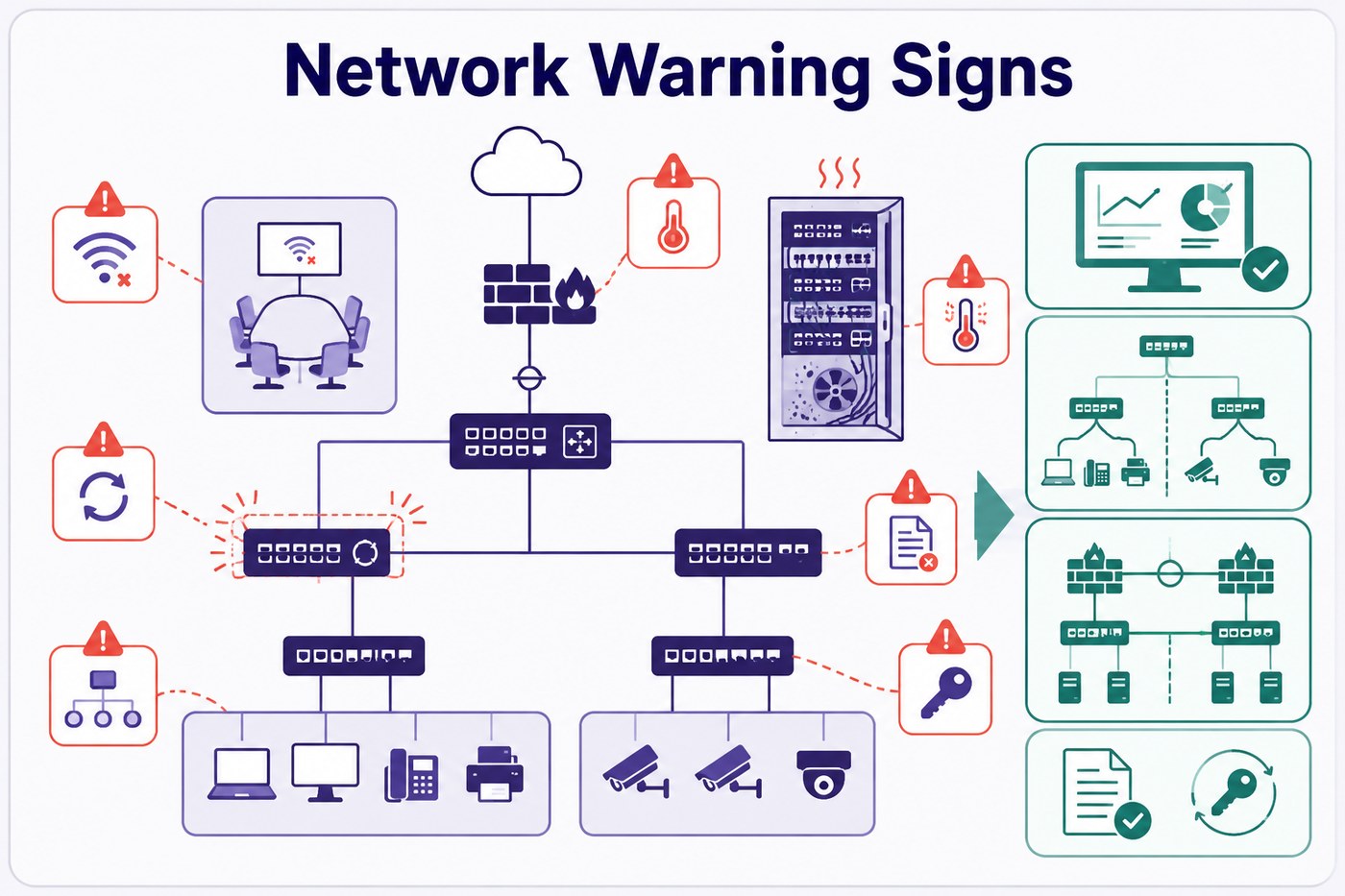
When a company calls us after a network disaster, the post-mortem almost always finds the same thing: the failure had been announcing itself for months. Nobody was listening, because nobody knew what the announcements sound like. Here are the seven we hear most often.
1. “The Wi-Fi is bad in the meeting room”
Chronic dead zones mean the access points were placed where the ceiling was convenient, not where a survey said. Annoying today, but the same guesswork usually extends to the whole design, which is why this complaint so often travels with the worse ones below.
2. Things fix themselves when you restart the switch
A restart that “fixes” the network is a symptom being silenced, not a problem being solved. Failing hardware, loops, or exhausted resources are underneath. Each restart buys days and destroys the evidence.
3. Nobody has a diagram
If no drawing of the network exists, every outage starts with archaeology. Undocumented networks take many times longer to fix, and are impossible to secure, because nobody can say what is connected to what.
4. Everything is on one network
Printers, laptops, CCTV, guests’ phones and the server all seeing each other means one infected laptop can reach everything you own. Segmentation is not an enterprise luxury; it is the difference between an incident and a catastrophe.
5. The switch cupboard is warm and full of dust
Heat is the quiet killer of network hardware, very relevant in this region. Equipment in unventilated cupboards, or racks used as storage shelves, fails years early and always at the worst time.
6. One box, one cable, one prayer
Ask: which single device, if it dies now, stops the whole office? If the answer comes fast, you have a known single point of failure with no plan. If nobody can answer, it is worse.
7. The person who set it up has left
Passwords in one departed head, configurations never exported, a firewall nobody dares touch, this is the most common state we find. The network works until the first change is needed, and then it cannot be changed safely at all.
What to do with this list
Count your matches. One or two: put them on a plan. Three or more: your network is running on luck, and an assessment (a survey, a diagram, a risk list with costed fixes) is a small project that turns luck back into engineering. That assessment is exactly the kind of work we do; the outcome is a document you can act on with anyone, not a sales funnel.
Is your network telling you something?
Tick everything that is true of your office today. Each unticked line is one of the warning signs in this article.
A prompt for the right conversation, not an audit. A real assessment looks at configuration, logs and traffic, not just at what is true in principle.
Start with a conversation
An initial consultation with a consultant rather than a salesperson, about your IT, security or systems question.